
Sitemap
A list of all the posts and pages found on the site. For you robots out there is an XML version available for digesting as well.
Pages
Posts
portfolio
publications
Simulation of a wingtip vortex flow with Linear Eddy Viscosity turbulence models at Re=4.6E6 and Re=1.2E6
Politecnico di Milano, Universitè de Liege 2022
Linear Eddy Viscosity Models, wingtip vortex, Large Eddy Simulations, Reynolds Average Navier-Stokes simulations.
Data-driven modeling of near-wall turbulence using β-variational autoencoder, transformers, and adversarial loss
11th International Symposium on Turbulence Heat and Mass Transfer (THMT-25) 2025
Near-wall turbulence, Reduced-Order Models, Minimal channel, Transformers, Variational Autoencoder, Generative Adversarial Networks
Recommended citation: Tonioni, N., Umair, M., Agostini, L., Kerhervé, F., Cordier, L., & Vinuesa, R. (2025). Data-driven modeling of near-wall turbulence using β-variational autoencoder, transformers, and adversarial loss. THMT-25, Tokyo, Japan.
Download Paper
VIVALDy: A Hybrid Generative Reduced-Order Model for Turbulent Flows, Applied to Vortex-Induced Vibrations
Physical Review Fluids 2026
Machine-Learning, Deep Learning, Reduced-Order Models, Turbulent Flows, Vortex-Induced Vibrations
Recommended citation: Tonioni, N., Agostini, L., Kerhervé, F., Cordier, L., & Vinuesa, R. (2026). VIVALDy: A Hybrid Generative Reduced-Order Model for Turbulent Flows, Applied to Vortex-Induced Vibrations. Physical Review Fluids, 11, 044902.
Download Paper
talks
Reduced-oreder modeling of experimental turbulent flows: from linear projection-based methods to autoencoders
Published:
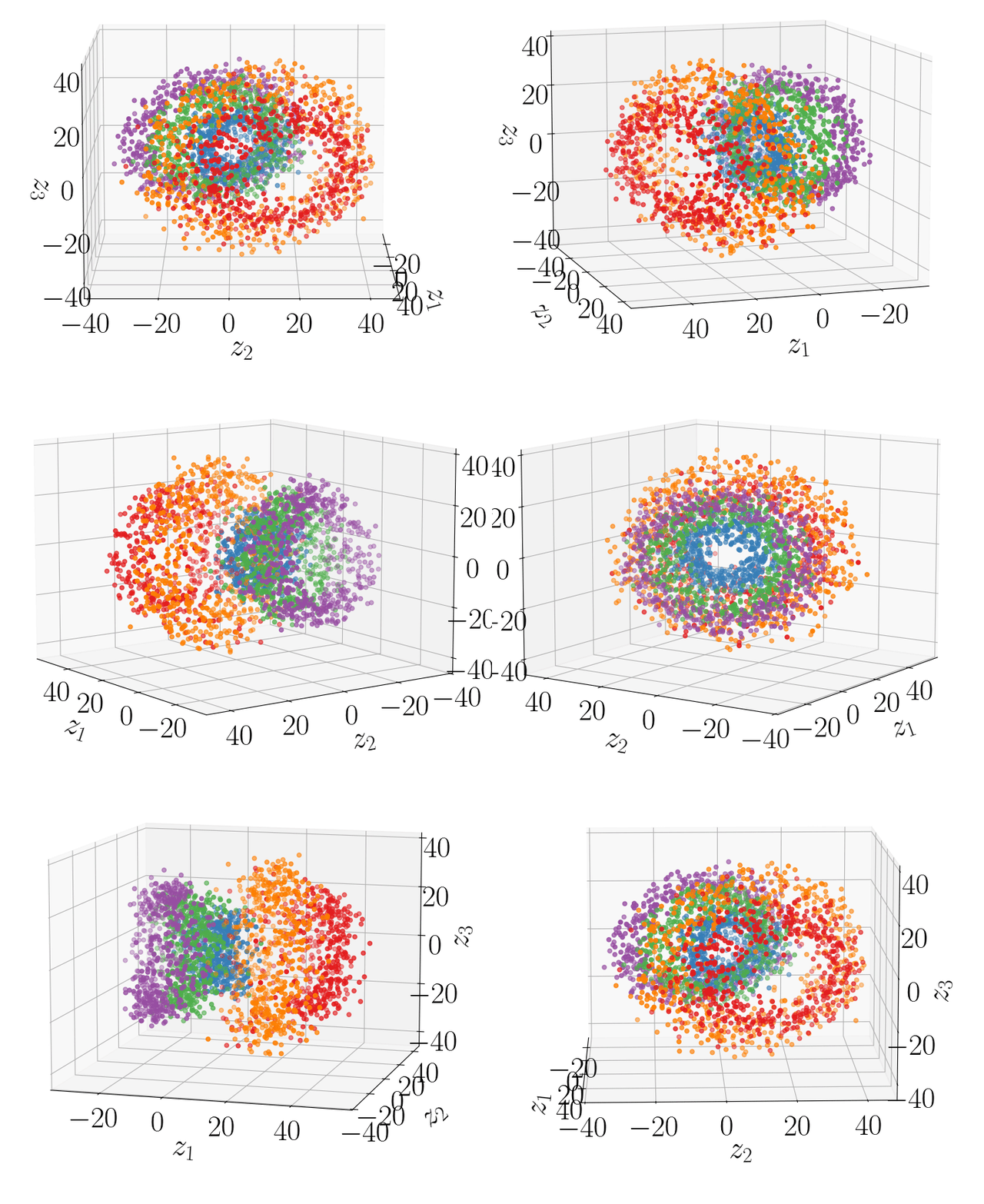
Can deep learning effectively compress and reconstruct turbulent flows? I will present our analysis, exploring autoencoders (AEs) and variational autoencoders (VAEs). We address key questions: How well do AEs and VAEs reconstruct the flow at extreme compression rates? How are the learned mappings structured in the reduced subspace? Do these latent representations correlate with key flow parameters?
Data-driven modeling of near-wall turbulence using β-variational autoencoder, transformers, and adversarial loss
Published:
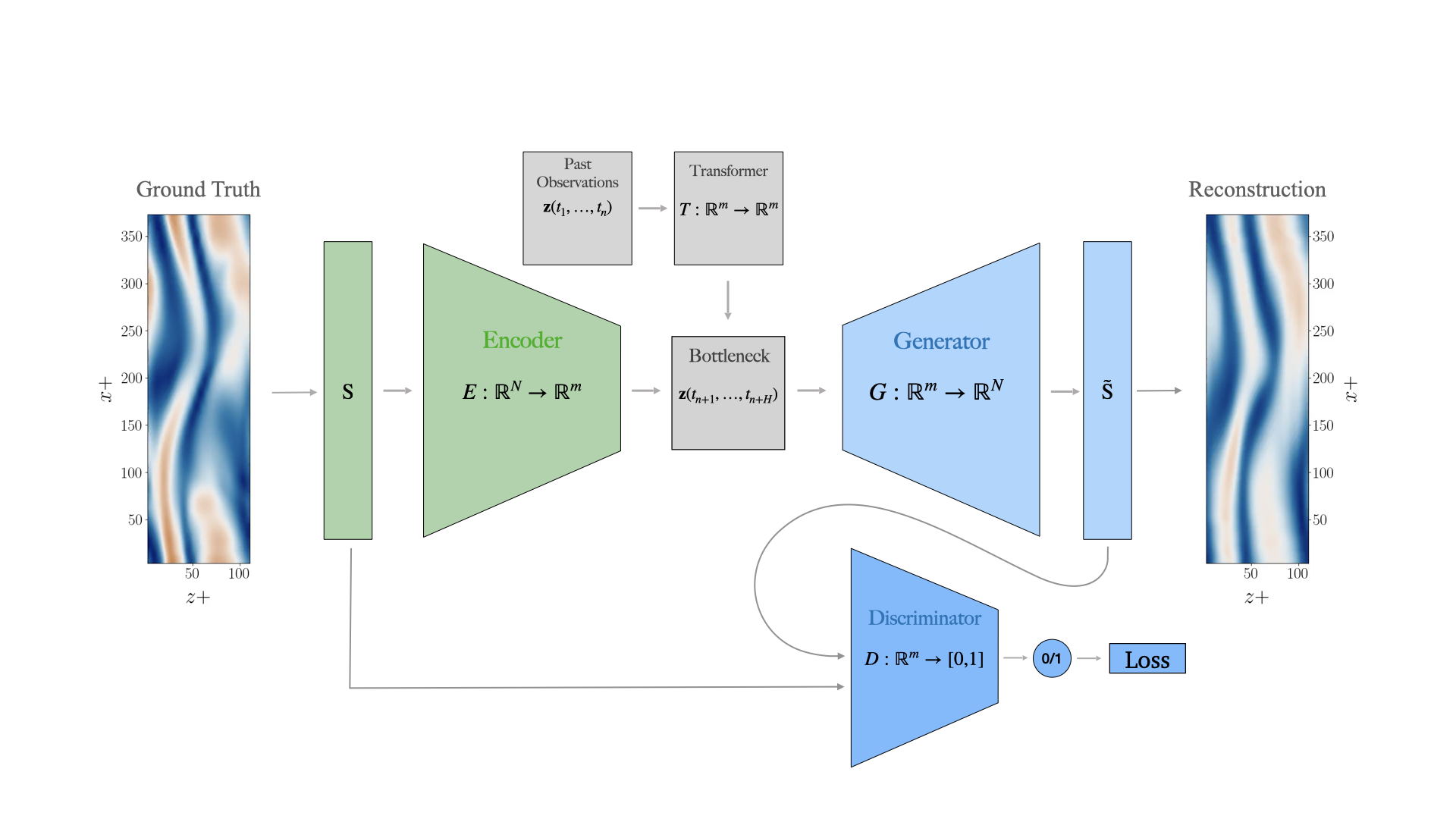
Can machine learning help us understand and predict near-wall turbulence? In this talk, I presented a framework combining a β-variational autoencoder (β-VAE) for unsupervised feature extraction and a unidirectional transformer for temporal prediction of turbulent channel flows. Using minimal channel simulations at \(Re_\tau = 200\), we assess the framework’s ability to capture compact, interpretable representations and forecast flow dynamics. Validation includes energy spectra, quadrant analysis, and dynamical tools such as Lyapunov exponents and Poincaré maps.
Vivaldy: AI-Driven Low-Order Modeling of Vortex-Induced-Vibrations
Published:
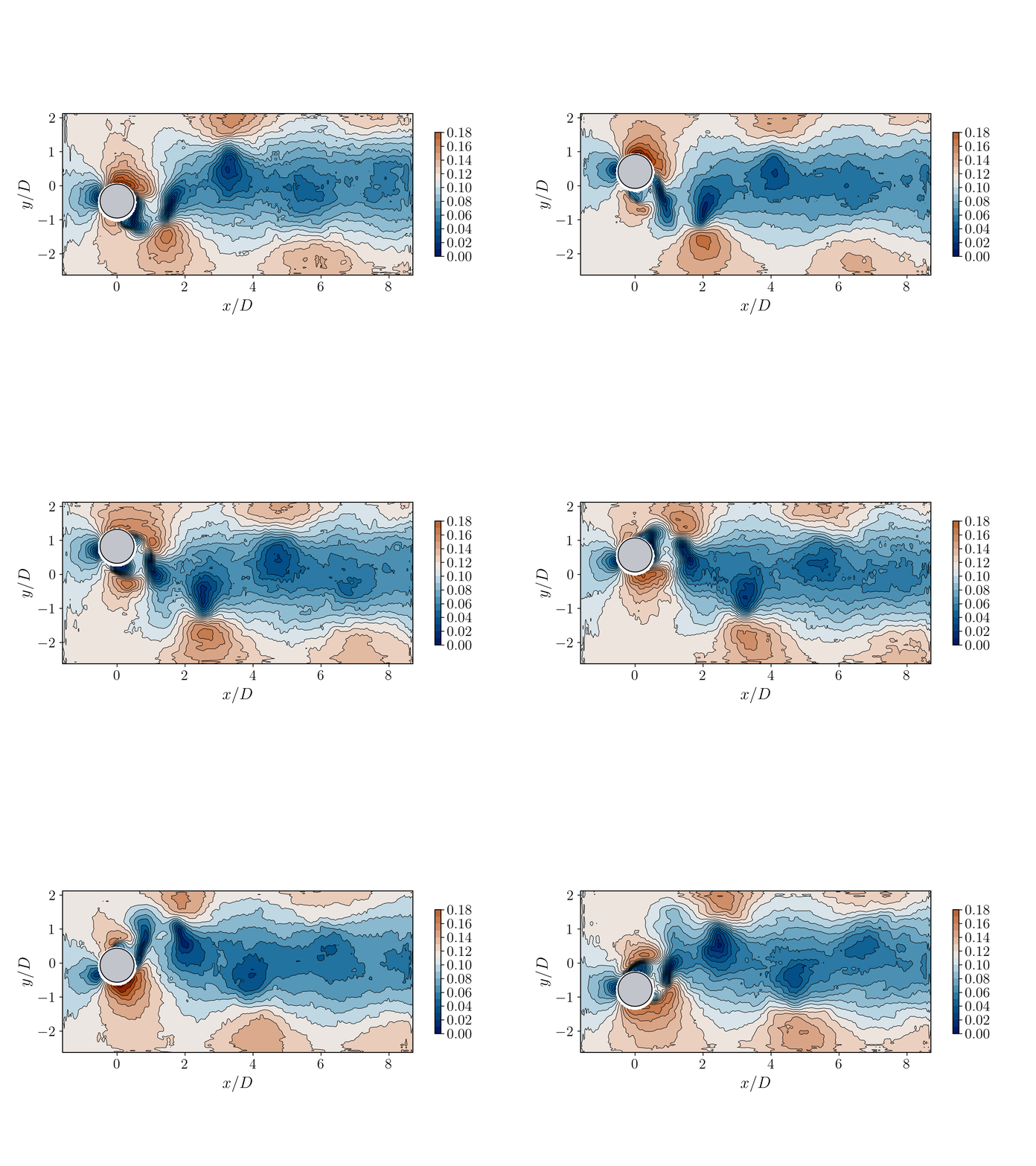
How can we efficiently model turbulent flows in vortex-induced vibration (VIV) systems for energy harvesting? In this talk, I introduced VIVALDy, a deep generative framework combining a β-VAE-GAN with masked convolutions and a bidirectional transformer. The model learns compact, interpretable latent representations of flow fields while accurately predicting their evolution using only the cylinder displacement as input. Validated against experimental data across a range of Reynolds numbers, VIVALDy achieves superior reconstruction accuracy and better captures flow statistics than traditional reduced-order models—opening new directions for control and design of VIV-based energy systems.
Data-driven modeling of near-wall turbulence using β-variational autoencoder, transformers, and adversarial loss
Published:
This talk presented an extension of the work shown at EUROMECH 629, with a deeper analysis of latent space forecasting for near-wall turbulence. The framework combines a β-variational autoencoder (β-VAE-GAN) for unsupervised feature extraction and a decoder-only transformer for temporal prediction, validated on minimal channel flow simulations at \(Re_\tau = 200\). The extended analysis demonstrates that the model accurately predicts latent space dynamics, preserves chaotic characteristics, and enables accurate reconstruction of low-velocity streaks and dominant momentum transport mechanisms within one Lyapunov time.
Navigating the Intermittency: A Generative Surrogate for Long-Horizon Forecasting of Minimal Flow Unit from Sparse Measurements
Published:
This work introduces an equation-free, data-driven reduced-order model for wall-bounded turbulent flows, designed for potential integration into active control loops. The framework integrates a β-VAE-GAN for non-linear spatial dimensionality reduction with a sensor-conditioned Easy Attention Transformer for temporal evolution. Evaluated on the Minimal Flow Unit at \(Re_\tau = 200\) at \(y^+ = 14\), the architecture compresses the flow into a four-variable latent space while preserving the turbulent kinetic energy and integral length scales. This learned manifold autonomously isolates the low-frequency signatures of the near-wall intermittent regeneration cycle. By conditioning the Transformer on three sensors, the model sustains accurate latent trajectories over extended horizons from a minimal initialization window. End-to-end inference reconstructs flow fields near the upper limit of the compression stage, with quadrant analysis confirming the accurate capture of dominant ejection and sweep events. While extreme bursts are slightly attenuated, the framework's ability to track alternating active and quiescent phases demonstrates its potential as a robust state-estimator for future model-based control applications.
Download Download Slides
</p>teaching
Teaching Assistant - Aerodynamics
Undergraduate course, Isae - École Nationale Supérieure De Mécanique Et D'aérotechnique, 2025
Responsibilities included:
- Leading tutorial sessions and problem-solving workshops
- Providing student support during office hours